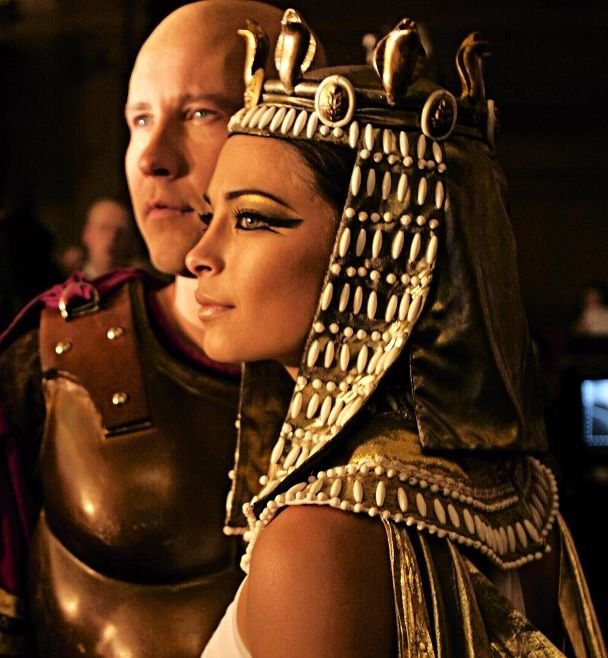
In the annals of history, few figures captivate the imagination quite like Cleopatra VII Philopator, whose dramatic life intertwined irrevocably with the fate of the Roman Republic. Her saga, an intricate dance between ancient Egypt and the burgeoning power of Rome, is often distilled into a narrative of fatal attraction and ultimate collapse. Yet, to truly grasp the monumental impact of Cleopatra, Rome, Caesar, and Antony is to delve beyond mere romance, uncovering a sophisticated political game played with the highest stakes imaginable: love, loyalty, ambition, and treason. This isn't just history; it's a blueprint of power, a testament to a queen who fought against an empire, shaping its very trajectory in the process.
At a Glance: A Queen, Two Romans, and an Empire's Birth
- Cleopatra VII: The last pharaoh of Egypt's Ptolemaic Dynasty, a brilliant, multilingual ruler renowned for her charm, intellect, and strategic acumen, not just her beauty.
- Julius Caesar: Rome's most ambitious and successful general, a statesman whose pursuit of Pompey led him to Egypt and into Cleopatra's orbit, fundamentally altering both their lives.
- Mark Antony: Caesar's loyal lieutenant, a formidable military commander who, after Caesar's death, formed a powerful alliance—both political and personal—with Cleopatra, aiming to secure control of the Eastern Roman territories.
- Octavian (later Augustus): Caesar's adopted son and heir, whose methodical rise to power ultimately pitted him against Antony and Cleopatra, leading to the decisive Battle of Actium and the birth of the Roman Empire.
- The Stakes: The survival of the Ptolemaic Kingdom, the political stability of Rome, and the ultimate shape of the Mediterranean world.
The World They Inherited: A Looming Clash of Titans
Imagine the Mediterranean in the mid-first century BCE. To the east lay Egypt, a jewel in the crown of the legacy of ancient Egyptian dynasties. For nearly three centuries, it had been ruled by the Ptolemies, descendants of Alexander the Great's general, Ptolemy I Soter. Their capital, Alexandria, was a dazzling cosmopolitan hub, famed for its library, lighthouse, and immense wealth derived from the fertile Nile delta and lucrative trade routes. Yet, despite its grandeur, the Ptolemaic kingdom was a shadow of its former glory, increasingly reliant on Roman patronage to maintain its fragile independence amidst internal family squabbles and the growing shadow of Rome.
Meanwhile, to the west, the Roman Republic, an unstoppable force, had conquered vast territories, from Hispania to Greece, Gaul to Asia Minor. Its armies were unmatched, its political system complex, but beneath the surface, profound cracks were forming. Decades of expansion had fueled immense wealth for some, deepened social divisions, and, crucially, led to a series of devastating civil wars that ripped apart the very fabric of the Republic. This was the tumultuous end of the Roman Republic, a period of unprecedented instability where powerful generals vied for supreme control, bypassing traditional institutions and paving the way for one-man rule.
Into this volatile crucible, Cleopatra was born. Inheriting a kingdom teetering on the brink and a family rife with internal dissent, she was groomed for survival in a treacherous world. Her father, Ptolemy XII Auletes, notoriously weak and subservient to Rome, designated her and her younger brother, Ptolemy XIII, as co-rulers. This was a common Ptolemaic practice, but one that almost invariably led to bitter power struggles – and Cleopatra, with her keen intellect and formidable ambition, was not one to share power meekly.
Cleopatra's Ascent: A Queen Against the Odds
The prophecy of conflict quickly materialized. Factional struggles at the Alexandrian court saw Cleopatra expelled from the city by the supporters of her younger brother, Ptolemy XIII. Forced into exile near the Egyptian-Syrian border, she wasn't defeated; she was strategizing, meticulously assembling her own army, preparing for an invasion to reclaim her rightful throne.
It was at this precise moment that the Roman Civil War catastrophically spilled onto Egyptian shores. Gnaeus Pompey Magnus, Julius Caesar's rival and former ally in the First Triumvirate, fleeing a crushing defeat at Pharsalus, sought refuge in Egypt. Ptolemy XIII's advisors, foolishly believing they could curry favor with the ascendant Caesar, made a disastrous miscalculation: they had Pompey murdered and presented his severed head to Caesar upon his arrival. This act, intended to please, instead horrified Caesar, who saw it as an affront to Roman dignity and hospitality, and a dangerous presumption of Egyptian power.
Caesar arrived in Alexandria, ostensibly to mediate the dispute between the siblings and enforce the will of Ptolemy XII, but in reality, to secure Rome's interests and settle the political chaos that threatened to destabilize a vital grain supplier. He summoned both Cleopatra and Ptolemy XIII to his presence. Ptolemy XIII arrived openly, but Cleopatra, aware of the dangers and knowing she had to make an unforgettable impression, chose a more dramatic entrance.
The Rug and the Roman: Legend has it, and historical accounts largely confirm, that Cleopatra had herself smuggled into Caesar's palace, wrapped in a large rug or a bedroll, carried by a loyal servant. When unrolled before Caesar, she emerged, a young queen in the prime of her life, described as stunningly beautiful, but more importantly, possessing a magnetic charm, quick wit, and a command of multiple languages that allowed her to converse directly with Caesar in his native Greek. It was a calculated risk, a masterstroke of political theater. She didn't just meet Caesar; she enchanted him. Her intelligence and persuasive power were as potent as her allure.
Caesar, captivated, ordered the execution of Ptolemy XII's will, decreeing that Cleopatra and Ptolemy XIII should rule together. This decision ignited a brief, fierce conflict known as the Alexandrian War, where Caesar's small Roman force, aided by Cleopatra's loyalists, ultimately triumphed over Ptolemy XIII's army. Ptolemy XIII drowned in the Nile, and Cleopatra's position was solidified. She later married her youngest brother, Ptolemy XIV, to maintain the dynastic tradition, but she was now the undisputed ruler of Egypt, thanks to Roman backing.
The Serpent and the Eagle: Cleopatra and Julius Caesar
Their relationship was more than a fleeting affair; it was a profound political alliance and a deeply personal bond. Caesar, a man of immense ambition and intellect, found his match in Cleopatra. She bore him a son, Caesarion (Little Caesar), further cementing their connection. She even journeyed to Rome, living in Caesar's villa, a visible testament to their bond and Egypt's special status within Rome's sphere of influence. For Cleopatra, Caesar was her guarantor of power, her shield against internal enemies and Roman annexation. For Caesar, Egypt's wealth was a crucial resource for his ongoing campaigns, and Cleopatra was a valuable, intelligent ally.
However, Caesar's growing power and his relationship with an Eastern queen fueled intense unease in Rome. His dictatorial tendencies and imperial ambitions ultimately led to his assassination on the Ides of March in 44 BCE. This seismic event plunged Rome back into civil war, leaving Cleopatra vulnerable and forcing her to navigate a new, even more dangerous political landscape. With Caesar dead, her primary protector was gone, and the future of her dynasty once again hung in the balance. She quickly returned to Egypt, where she likely arranged the quiet elimination of her co-ruler, the young Ptolemy XIV, solidifying her sole power and securing Caesarion as her undisputed heir.
A New Roman Architect: Mark Antony Enters the Fray
Caesar's assassination triggered a brutal power struggle among his potential successors. The key players who emerged were Mark Antony, Caesar's most trusted general and loyal lieutenant; Octavian, Caesar's young, adopted son and shrewd political heir; and Marcus Aemilius Lepidus, another of Caesar's generals. Together, they formed the Second Triumvirate, a legally sanctioned dictatorship aimed at restoring order and punishing Caesar's assassins.
After the decisive Battle of Philippi in 42 BCE, where the forces of the Triumvirate crushed Brutus and Cassius (Caesar's chief assassins), the Roman world was carved up. Antony took charge of the wealthy Eastern provinces, responsible for restoring order, raising funds, and ensuring loyalty to the new regime. It was in this capacity that he summoned Cleopatra to meet him in Tarsus (modern-day Turkey) in 41 BCE.
Antony, a charismatic soldier known for his love of luxury and grand gestures, needed Cleopatra. He needed Egypt's immense wealth, particularly its grain, to provision his legions and fund his political ambitions. Cleopatra knew this was her chance to forge a new alliance, to protect her kingdom and ensure her son's future.
The Siren and the Soldier: Cleopatra and Mark Antony
Cleopatra's journey to Tarsus was another spectacle of calculated power. She arrived not as a supplicant but as a queen, sailing up the Cydnus River in a gilded barge, adorned like Aphrodite, surrounded by attendants dressed as cupids and nymphs. The air was thick with the scent of burning incense, and the shore was thronged with awe-struck crowds. Antony, who had expected her to come to him, was instead drawn to her, immediately falling under her spell.
Their relationship blossomed into a profound, decade-long partnership, both political and personal. They had three children together: twins Alexander Helios and Cleopatra Selene, and a son, Ptolemy Philadelphus. For Cleopatra, Antony represented the best chance for Egypt to maintain its independence and even expand its influence. Through Antony, she hoped to establish a buffer state of allied kingdoms, ruled by her children, against the ever-encroaching Roman Republic. For Antony, Cleopatra provided not only immense financial support but also a deep personal connection and a vision for the East that resonated with his own grand ambitions.
However, their alliance profoundly alienated public opinion in Rome, meticulously orchestrated by Octavian's propaganda machine. Octavian painted Antony as a degenerate, enslaved by an exotic foreign queen, abandoning his Roman duty for Eastern decadence. Cleopatra was depicted as a seductive sorceress, a threat to Roman morals and the Republic itself. When Antony made controversial "Donations of Alexandria" in 34 BCE, formally granting Roman territories to Cleopatra's children, and declared Caesarion as Caesar's true heir, Octavian had all the ammunition he needed. Antony was effectively challenging Octavian's legitimacy and threatening the stability of the Roman world order. The stage was set for the ultimate confrontation.
The fierce rivalry between Caesar, Antony, and Octavian had now reached its boiling point.
The Final Act: Clash of Titans and a Dynasty's End
The inevitable showdown came in 31 BCE at the Battle of Actium, off the western coast of Greece. It was a massive naval engagement between the combined fleets of Antony and Cleopatra against Octavian's forces, led by his brilliant admiral Agrippa.
The battle itself was a chaotic affair. As the fighting raged and Antony's fleet suffered setbacks, Cleopatra, with her squadron, suddenly broke formation and sailed away, heading back to Egypt. Accounts differ on why she did this—was it a planned strategic retreat to preserve her fleet, a desperate attempt to escape, or a panicked flight? Whatever the reason, Antony, seeing her withdrawal, immediately abandoned his fighting forces to pursue her, a move that proved disastrous. His remaining fleet, demoralized and leaderless, was annihilated. The Battle of Actium was a decisive victory for Octavian, sealing the fate of Antony and Cleopatra.
With his legions deserting and his naval power crippled, Antony's position was hopeless. Octavian pursued them to Egypt in 30 BCE, besieging Alexandria. Antony, receiving false news of Cleopatra's death, fell on his sword, committing suicide. He was brought, still alive, to Cleopatra, dying in her arms.
Cleopatra, captured by Octavian, made a desperate final attempt to negotiate, hoping to preserve her children's inheritance or at least ensure Caesarion's safety. She tried to charm Octavian, as she had charmed Caesar and Antony, but Octavian, a colder, more calculating figure, was impervious to her allure. He intended to parade her through Rome as a captive in his triumph, a humiliation she absolutely refused.
In a final act of defiance and dignity, Cleopatra committed suicide. The precise method remains a subject of debate—whether by an asp smuggled in a basket of figs or by a potent poison—but the outcome was clear. She died on August 12, 30 BCE, effectively ending the Ptolemaic Dynasty and, with it, the last vestige of independent Hellenistic kingdoms. Egypt became a Roman province, a personal possession of the new emperor. Caesarion, Cleopatra's son by Caesar, was executed on Octavian's orders, eliminating any potential rival to his claim as Caesar's heir.
Echoes Through Time: Cleopatra's Enduring Legacy
The tragic end of Cleopatra, Antony, and the Ptolemaic Dynasty marked a profound turning point in history. Octavian, having eliminated all rivals, consolidated his power and, in 27 BCE, formally transitioned the Roman Republic into the Roman Empire, becoming its first emperor, Augustus. The centuries of civil war were over, giving way to the Pax Romana, an era of unprecedented peace and prosperity—a direct consequence of the events that unfolded around Cleopatra.
Cleopatra herself transcended history to become a legendary figure. She has been depicted as a femme fatale, a brilliant statesman, a tragic lover, and a cunning manipulator. Her story, a potent mix of sex, power, and political intrigue, has inspired countless works of art, literature, and film, from Shakespeare's "Antony and Cleopatra" to modern blockbusters. She remains the ultimate symbol of a queen who dared to challenge the might of Rome, who wielded personal charm and political acumen as weapons, and whose choices irrevocably altered the course of Western civilization.
The story of Cleopatra, Rome, Caesar, and Antony is more than just ancient history; it's a timeless exploration of ambition's allure and power's price. It reveals how individual choices can ripple through empires, how alliances can be forged and shattered, and how even the most powerful figures can be undone by a combination of personal passion and political machinations. It's a reminder that beneath the grand narratives of empires, human desires, vulnerabilities, and strategic brilliance ultimately drive the course of destiny.
To delve deeper into the rich tapestry of her life and times, consider works like Jacob Abbott's "Cleopatra: Roman Civil War and the Fall of the Ptolemaic Dynasty," which meticulously details her strategies and the geopolitical context of her reign. For a more comprehensive understanding of this iconic queen, explore The complete guide to Cleopatra.